Artificial intelligence has long since arrived in practice. Many companies are experimenting with chatbots, automated evaluations, or generative tools, but when it comes to digital learning, the question often remains: What does AI actually bring in a corporate context? And even more importantly: How can you use AI in your e-learning tool to make learning more efficient, personalized, and motivating, without overwhelming your team with the new technology?
This article shows you the most important ways that AI is already supporting digital training today. And it does so in a practical, realistic manner that is oriented around what actually works in modern learning environments.
What does AI-supported learning even mean?
AI-supported learning describes learning processes in which artificial intelligence supports learners, adapts learning content, or provides feedback. Unlike traditional learning platforms, AI can recognize patterns, generate suggestions, or formulate answers. The goal of the AI function is not to replace instructors or HR developers, but rather to make the learning processes smarter.
Three characteristics are typically involved:
Personalization: The learning content adapts to the behavior and knowledge level of the learners.
Automation: Functionalities such as evaluations, summaries, or feedback partially occur automatically.
Quick support: Questions, problems, or uncertainties of course participants are answered immediately without waiting times.
For companies, this means: less manual work for instructors and HR developers, better learning progress for course participants, and a higher participation rate.
The 5 most sensible application areas for AI in corporate learning
For AI to truly make a difference in everyday corporate life, it must solve concrete challenges. These five use cases have proven particularly effective:
1. AI as a learning companion in the course: quick answers and available anytime
The most immediate benefit: AI can answer learners' questions, explain learning content, provide examples, or offer in-depth learning material.
In traditional online courses, learners are usually left to their own devices. When they have questions, they must wait for the instructor to respond. This is where AI shines: An AI coach or chat-based assistance system answers questions immediately around the clock and refers to the learning material it was trained on.
It's important: AI does not replace personal support. It relieves instructors, answers standard questions, and ensures that course participants do not get stuck. For more complex issues, the instructor or trainer is still responsible.
2. Automated feedback: assistance with tasks and exercises
Many companies and HR developers desire more exercises and tests in their digital courses, but manual evaluation and feedback from the instructor to learners requires a lot of time. AI can take over some routine tasks for you:
✅ Analysis of responses in free text fields
✅ Suggestions for learners to improve their answers
✅ Step-by-step explanations for questions and exercises
✅ Suggestions for review tasks to reinforce learning
The advantage: Course participants receive immediate feedback, which has been shown to increase their motivation and learning success. Instructors and trainers, in turn, are noticeably relieved and can focus on other tasks.
3. Personalized learning paths: appropriate and individual learning content
Not all learners start a course with the same prior knowledge. AI can help automatically tailor learning content to the individual knowledge level:
Which lessons are relevant for the course participant?
Which topics has the course participant already understood well?
Which exercises should the course participant repeat?
Which learning formats work best for the course participant?
The learning path is oriented around the individual's learning progress in the course. This makes digital learning more efficient and ensures that course participants feel better supported.
4. Summaries & knowledge preparation: ideal for busy teams
One of the most commonly used applications of AI is condensing content. When creating courses, you can automatically summarize lengthy technical texts, extensive documentation, or training materials. For course participants, this means: faster entry, clearer orientation, and less time investment.
Also popular are:
Bullet point summaries
Short explanatory texts
Automatically generated flashcards
Compact reviews at the end of a module
This makes complex knowledge understandable without you as a course creator having to prepare everything manually.
5. Automated evaluation of learning progress
AI can analyze large data sets and immediately show where learners stand. This helps you as an HR developer because you no longer have to painstakingly evaluate Excel sheets or manually go through learning statistics.
The benefits for instructors and course authors:
👍 Identify learning content or topics that many course participants find difficult
👍 Identify course sections with a high drop-out rate
👍 Determine the need for further training
👍 Reporting for management without manual preparation of learning progress
This allows you to continuously improve and develop your courses and the training processes for your employees.
✨ This is how AI specifically supports you in course creation
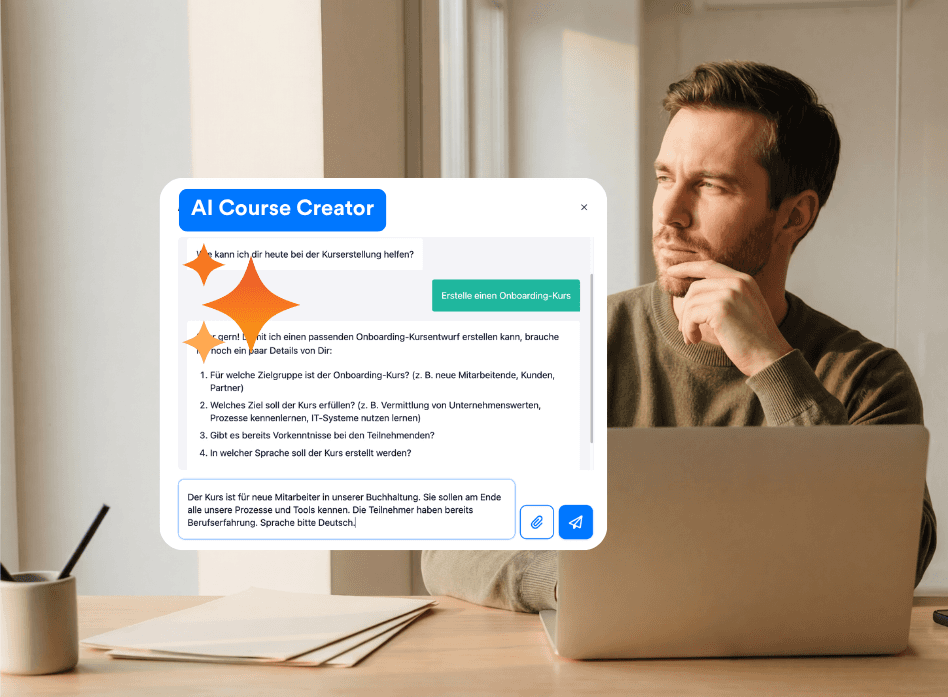
A particularly practical use of AI in e-learning is the support in course creation. Instead of starting from scratch, AI develops a structured course template with chapters and learning units from your course topic. Thus, you not only use AI situationally in the course but also utilize it directly for the entire structure of your further education.

What AI cannot do, and why this is important
As powerful as AI has become, there are clear limits to the use of AI functions that HR teams and companies should be aware of:
1. AI does not make strategic decisions.
It can make suggestions but cannot prioritize or evaluate corporate goals.
2. AI does not replace the didactic concept.
AI can support and complement learning content but cannot make up for a lack of structure or unclear learning goals.
3. Every AI is only as good as the data it was "trained" on.
AI can only work with what is made available to it. Accordingly, poor or incomplete learning materials directly affect the results that AI delivers.
4. An AI needs clear framework conditions.
Especially in learning, data protection is a big issue. When using AI functions in e-learning, your company should clearly define which content may be processed by the AI and which may not.
In short: AI is a tool. Its utility is determined not by the technology but by how systematically and meaningfully you utilize it.
Benefits for companies: Why AI-supported learning convinces
When used correctly, AI tools and functions provide tangible benefits. The most important advantages:
✔️ Less effort for HR and trainers
Standard questions, feedback, evaluations, summaries: many time-consuming tasks run automatically. This creates room for personal support of learners.
✔️ Better learning results
Immediate feedback, personalized learning paths, and clear explanations ensure that learners advance faster and give up less often.
✔️ Higher motivation of learners
When questions are answered directly and content is clearer, course participants feel supported. Courses then seem less like a "duty" and more like a real help for everyday work.
✔️ Scalability for large teams
AI is available at all times and does not require more time when 50 or 500 people learn simultaneously. This makes corporate learning more manageable—and cheaper.

How companies can start with AI – pragmatically and without complex IT projects
Many decision-makers within a company immediately think of extensive IT system integrations when introducing AI tools. In practice, however, it often suffices to start small first and observe for a while how the use of AI features actually "feels" and how much acceptance it finds among users.
Here are three realistic entry points:
1. Activate AI support directly in the course
Modern learning platforms offer AI coaches that can be directly integrated into existing courses. Answering questions, providing feedback, explaining content—all of this happens without technical barriers.
2. Improve learning content with AI
Whether summaries, review questions, or microlearning formats: AI can quickly optimize existing learning material without needing to create new content.
3. Automate processes in training
Reporting, feedback, evaluations: Many tasks can now be AI-supported and run without additional tools.
It's important: Start with one use case. Not all ideas need to be implemented at once.
What really matters in implementation
AI provides the technology. Whether it truly works in your company is determined by clear rules, clean processes, and responsible usage.
1. Transparency
Employees or course participants must understand what AI is used for and how they benefit from it. The clearer the communication, the higher the acceptance.
2. Data protection
Especially with AI systems, it is essential to work only with GDPR-compliant solutions and clearly define how content is processed.
3. Didactic quality
AI can support and complement learning content. However, whether learning truly works still depends on clear learning objectives, a clean structure, and well-prepared content.
Conclusion: AI-supported learning is no longer a future topic
💡 AI-supported learning sustainably enhances the value of corporate training when it is didactically embedded, strategically managed, and responsibly used.
Artificial intelligence is already more than an experiment in corporate learning. It can accelerate learning processes, automate routine tasks, and enable individual support. Companies benefit particularly when they define concrete use cases and apply the technology in places where it creates real added value.
The balance is crucial: AI takes over analysis, feedback, and structuring, while HR, trainers, and executives remain responsible for content quality, strategic direction, and personal support.
Those who clearly define this framework make AI not an isolated feature but an integral part of modern learning processes. This creates training that is efficient, scalable, and remains human at the same time.